Switzerland
A country assembled from the passes between its valleys rather than from a people, a language, or a king — and the only one that answered its own mountains by building railways up them.
The central idea
Switzerland is best understood as a federation of valleys connected through their few usable gaps—first as passes, then as railways, and finally as journeys in their own right. Its neutrality, its languages, its federalism, and its tourism are all downstream of the same fact: the mountains made central rule impractical and made the routes through them valuable. The honest way to plan a trip here is to follow that logic and treat the railway, not only the summit, as part of what you came for.
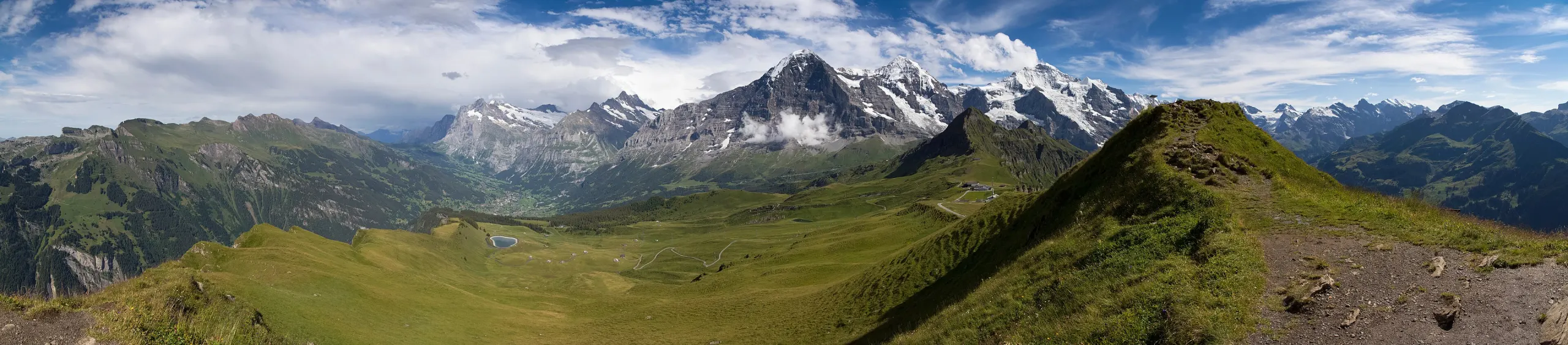
Switzerland is not a nation in the ordinary sense and never has been. It has no single language, no founding people, no monarch and no unifying myth that survives contact with the archive. It is a federation of valleys that agreed, over roughly six centuries, that they would rather negotiate with each other than be governed by anyone else — and the thing that made the agreement necessary was geography. The Alps do not merely decorate this country; they are the reason it has the shape, the politics, and the peculiar institutions it has.
To understand Switzerland, begin with four forces: the water, the pass, the pact, and the rail. The water is the Alpine watershed, which gathers Europe's rain and sends it out to four seas. The pass is the scarce, defensible gap between valleys that made these communities important to the empires around them. The pact is the habit of federation, of settling by treaty between equals rather than by conquest. And the rail is the nineteenth century's answer to all three: the decision, unique in Europe in its thoroughness, to drive railways not just through the mountains but up them, and in doing so to convert an obstacle into an export.
Place identity and geography
Switzerland is small, landlocked, and almost entirely defined by relief. The Alps fill the southern and central two-thirds, the Jura ridges run along the north-west, and between them lies the Mittelland — the plateau where most people actually live, where Zurich, Bern, Basel, and Lausanne sit, and which a visitor drawn by the mountains often crosses without noticing.
The country's real geographic distinction is hydrological rather than vertical. Switzerland straddles a major European watershed, and its rain leaves for four different seas: the Rhine north to the North Sea, the Rhône south-west to the Mediterranean, the Ticino south to the Adriatic by way of the Po, and the Inn east to the Black Sea by way of the Danube. To call it the water tower of Europe is not a slogan; it is a description of where the continent's rivers begin.
That relief is why the political map looks the way it does. Valleys that are hard to reach from each other develop separately, keep their own speech, and resist a capital. The result is a federation of cantons with a deliberately weak centre, a capital city — Bern — chosen partly for being no threat to anyone, and a habit of putting decisions to a vote rather than to a ruler. The mountains did not merely shelter Swiss democracy; they made a centralised alternative impractical.
For the visitor, the useful reading is that Switzerland is not one destination but a set of valley systems, each with its own access route, its own weather, and its own economy. The two this guide covers — the Bernese Oberland around Interlaken, and Lake Lucerne — are neighbours on the map and genuinely different trips on the ground. The country rewards choosing a valley and learning it far more than it rewards a lap.
Historical arc
The conventional beginning is 1291, when three valley communities around Lake Lucerne — Uri, Schwyz, and Unterwalden — swore a pact of mutual defence. The founding myth grew from that alliance and eventually acquired William Tell, who is very probably a story. What is not a story is the geography behind it: those communities sat at the northern end of the Gotthard route, and controlling that route made them worth both defending and buying. The Confederation's first asset was a pass.
Over the following two centuries the confederacy expanded, absorbed cities, and beat larger armies often enough to make Swiss infantry the most sought-after mercenaries in Europe — an export trade whose last visible trace is the Papal Swiss Guard. The 1515 defeat at Marignano ended the expansion and began the long turn inward that would eventually be called neutrality.
The Reformation split the confederacy along lines it never fully closed: Zwingli's Zurich and Calvin's Geneva against the Catholic inner cantons, including the very valleys that had founded it. For three centuries Switzerland was a loose and quarrelsome league rather than a country, held together mainly by a shared preference for not being ruled from outside.
The modern state is younger than most visitors assume. It was made in 1848, after the Sonderbund war — a civil conflict so short and so restrained that it killed only a hundred or so people, and whose settlement was notable for what the winners did not do to the losers. The federal constitution that followed built a state out of the compromise: a strong cantonal layer, a weak centre, and direct democracy as the release valve.
The nineteenth century then delivered the invention this country still lives on. British travellers had begun coming for the Alps, and Switzerland answered at industrial scale — hotels, funiculars, cogwheel railways, and finally the tunnels. The Gotthard rail tunnel opened in 1882; the Jungfrau Railway reached the Jungfraujoch in 1912 after sixteen years of boring through the Eiger and the Mönch. Alpine tourism was not something that happened to Switzerland. Switzerland built it.
Four languages and no national tongue
Switzerland has four national languages — German, French, Italian, and Romansh — and no Swiss language. This is not a technicality; it is the clearest evidence for what the country actually is. A nation founded on a people would have a tongue. A federation founded on treaties between valleys has whatever its valleys happened to speak.
German-speaking Switzerland, which is most of it, adds a further twist that surprises visitors: the spoken language is Swiss German, a set of Alemannic dialects that are not readily intelligible to a German speaker from Berlin, while the written language is standard German. People speak one and write the other, and the dialect is a point of pride rather than an embarrassment.
French-speaking Romandy occupies the west around Geneva and Lausanne, Italian-speaking Ticino the south beyond the Alps, and Romansh — a Rhaeto-Romance language descended from the Latin of the Roman province — survives in the valleys of Graubünden with a few tens of thousands of speakers. That Switzerland made it a national language at all is the federal reflex working exactly as designed.
For a traveller the practical point is simple: English is widely spoken in the tourism economy, and the language borders are crossed without ceremony on a train. The more interesting point is what the arrangement demonstrates — that a country can be held together by agreement about procedure rather than by agreement about identity.
Neutrality, federalism, and the institutions they produced
Swiss neutrality is old, deliberate, and armed — a policy rather than a temperament. Its modern form was recognised by the Congress of Vienna in 1815 and has been maintained through both world wars, and it has always been paired with a citizen army and compulsory service for Swiss men, with voluntary service for Swiss women, rather than with pacifism. The country's most photogenic institution, the militia system, exists because neutrality is a claim that has to be credible.
Federalism runs deeper here than almost anywhere. The cantons hold real power, the communes below them hold real power, and the federal government is left with what is genuinely national. Direct democracy sits on top: referendums and popular initiatives mean that citizens vote on specific questions several times a year, and that the answer is sometimes inconvenient for the government. It is slow by design.
The famous consequence of neutrality is humanitarian. After Henry Dunant witnessed the aftermath of the battle of Solferino, he became one of the five members of the Geneva committee founded in 1863 that became the ICRC. The first Geneva Convention in 1864 recognised the red cross on a white background as a protective emblem, reversing the colours of the Swiss flag. Geneva's later career as a seat of international organisations follows directly from the same logic: a country that is not a party to the quarrel is a useful place to hold the meeting.
The less flattering consequence is worth stating in the same breath. Neutrality has also meant banking secrecy, wartime trade with all sides, and a long, contested reckoning with dormant assets and refugee policy in the Second World War. A guide that presents Swiss neutrality only as humanitarian is telling half of it.
The Alps, the glaciers, and a worked landscape
The Swiss Alps are a young, steep, still-rising range, and the country's high ground is a catalogue of names that carry more weight than their altitude alone would explain: the Matterhorn's isolated pyramid, the Eiger's north face, the Jungfrau above its valley of waterfalls. Switzerland's highest peak is the Dufourspitze in the Monte Rosa massif; the Aletsch, the largest glacier in the Alps, runs down from the Jungfrau region and is inscribed as a UNESCO World Heritage site.
It is not a wilderness. The Alpine landscape is farmed, grazed, and managed to a degree that visitors from larger countries consistently underestimate — the meadows are hayfields, the treelines are managed, the high pastures are a working system with a seasonal rhythm of moving cattle up and down. What looks like nature is largely agriculture that has been photogenic for a very long time.
The valleys the traveller actually uses are shaped by ice. Lauterbrunnen is a textbook glacial trough with a flat floor and vertical walls that shed waterfalls; Lake Lucerne is a drowned, branching valley system that behaves more like a fjord than a lake. Reading a valley's shape tells you what it will be like to move around in, which is the practical half of Swiss landscape appreciation.
The glaciers are also the country's clearest environmental signal. They are retreating, measurably and rapidly, and their meltwater feeds the rivers of half a continent. The water tower is a real piece of European infrastructure, and it is changing.
The railway as the national work of art
If Switzerland has a cathedral, it is the timetable. The railway network is among the densest and most heavily used in the world, it is integrated so that trains, buses, and lake boats are timed to meet each other, and the culture of it — that a connection will hold, that the bus is waiting — is a genuine national achievement rather than a stereotype.
The engineering is the older layer. The Gotthard rail tunnel of 1882 put a railway under the pass that founded the country. A century and a bit later the Gotthard Base Tunnel, opened in 2016 at 57 kilometres, became the longest railway tunnel in the world and put a flat route through the Alps for the first time. The through-route the Confederation once taxed at the summit now runs beneath it.
The stranger achievement is the vertical one. Switzerland did not just tunnel through its mountains; it climbed them on rails. The Rigi got Europe's first mountain cogwheel railway in 1871, the Pilatus line of 1889 remains the steepest cogwheel railway in the world, and the Jungfrau Railway spent sixteen years boring up inside the Eiger and the Mönch to reach the Jungfraujoch at 3,454 metres in 1912. These were tourist projects, built speculatively for people who wanted the view.
That is the sense in which the railway is the point rather than the transport. The panorama routes are designed to be looked out of; the mountain lines exist because someone in the nineteenth century judged that a view would sell. A traveller who treats Swiss trains as the way to get to the scenery has the relationship backwards — the trains are what the country made of its scenery, and they are the most Swiss thing here.
- Gotthard: the pass that founded the Confederation, tunnelled in 1882 and undercut in 2016 by the 57-kilometre Gotthard Base Tunnel, the longest railway tunnel in the world.
- Rigi: Europe's first mountain cogwheel railway, opened in 1871 above Lake Lucerne — and one of three mountains a Swiss Travel Pass covers outright.
- Pilatus: the 1889 cogwheel line above Lucerne, the steepest in the world.
- Jungfrau Railway: sixteen years of boring inside the Eiger and the Mönch to reach the Jungfraujoch at 3,454 metres in 1912.
- Aletsch: the largest glacier in the Alps, a UNESCO World Heritage site, running down from the Jungfrau massif.
- The integrated timetable: trains, postbuses, and lake boats timed to meet — the least photogenic and most impressive thing in the country.
Local culture and way of life
Everyday Switzerland runs on a set of quiet agreements: that things work, that they are expensive, that Sunday is quiet, and that the rules — about recycling, about noise, about where you may and may not do a thing — are actually observed. Visitors read this as reserve. It is closer to a shared understanding that a country of this density and this many languages functions only if the procedure is respected.
The food is regional to a degree the fondue cliché conceals. Cheese and dairy dominate the Alpine cantons because that is what a high pasture produces; rösti and hearty cooking belong to the German-speaking side, while Ticino eats like northern Italy and Romandy like eastern France. Wine is made in serious quantity and drunk almost entirely at home — which is why the outside world barely knows it exists.
The traditions that survive are mostly working traditions rather than performances: the Alpabzug, when decorated cattle come down from the summer pastures in autumn, alphorns and yodelling as signalling and herding practices that became music, and the wrestling and stone-throwing of the Unspunnen and Schwingen tradition. They are taken seriously by the people doing them, which is what keeps them from being folklore.
And there is the cost, which is not incidental to the culture. Switzerland is expensive because wages are high and the franc is strong, and the visitor feels it at every meal and every ticket. The useful reframing is that the expensive things here are usually the engineered ones — the railway, the cable car, the tunnel — and those are precisely the things the country is best at. Paying for the mountain railway is paying for the thing itself.
From the watershed to the pass, the pact, and the railway.
Switzerland is treated here as a cultural and engineered landscape rather than a set of viewpoints: the water that leaves for four seas, the passes that made the Confederation worth founding, the federal habit that produced four languages and no national tongue, and the railways that turned all of it into an export.
A federation of valleys, not a nation
Four national languages and no Swiss language; a weak capital chosen for being harmless; cantons and communes that hold real power. Switzerland is held together by agreement about procedure rather than agreement about identity — the mountains made anything else impractical.
The pass was the first asset
Uri, Schwyz, and Unterwalden sat at the northern end of the Gotthard route, and controlling that gap is what made three valley communities worth defending. The Confederation began as a transit alliance with a mutual-defence clause.
The water tower of Europe
One small country's rain leaves for four seas: the Rhine to the North Sea, the Rhône to the Mediterranean, the Ticino to the Adriatic, the Inn to the Black Sea. The glaciers that feed them are continental infrastructure, and they are retreating.
Armed neutrality, and both of its faces
Recognised at Vienna in 1815, maintained through both world wars, and always paired with a citizen army. It produced the Red Cross at Geneva in 1863 and the Geneva Conventions — and also banking secrecy and a long, contested wartime reckoning. Both belong in the account.
The railway is the national work of art
Rigi's cogwheel line in 1871, Pilatus in 1889, the Jungfraujoch in 1912 after sixteen years inside the Eiger, the Gotthard Base Tunnel in 2016. Switzerland did not merely tunnel through its mountains; it climbed them on rails, speculatively, for the view.
Use the history to plan the costly parts of the trip.
That history explains why the railway is part of the experience. The next choices are practical: whether the pass beats the ticket, which base to choose, which village to sleep in, and which mountain earns its fare.
Lilu Lucerne 2027: light festival, stay and travel
Plan Lilu in Lucerne on 14–24 January 2027: choose a winter overnight base, distinguish walks from timed shows and check the last connection.
Swiss Travel Pass or point-to-point tickets: the honest arithmetic
2026 Swiss Travel Pass prices start at CHF 254 (2nd class, adults 25+). Compare the cost with point-to-point tickets and the Half Fare Card.
Interlaken or Lucerne: which base is right for your Swiss trip
Choose Lucerne for a lake city and mountain day trips; choose Interlaken when the Jungfrau valleys are the trip and transport access matters most.
Where to stay in the Jungfrau region
Compare Interlaken, Grindelwald, Lauterbrunnen, Wengen, and Mürren by rail access, car access, luggage, scenery, and evening atmosphere.
Is Jungfraujoch worth it? An honest answer before you buy
Decide whether Jungfraujoch is worth the live fare, understand the pass discounts, and compare Schilthorn, Grindelwald First, and Gornergrat.
Pilatus, Rigi, or Titlis: which Lake Lucerne mountain to actually do
Compare Pilatus, Rigi, and Titlis by journey, scenery, weather risk, and Swiss Travel Pass coverage before choosing a Lake Lucerne mountain day.
Switzerland without a car: when rail genuinely beats hiring one
Switzerland by car or train? Compare rail and driving, parking, and when a hire car still makes sense in the Bernese Oberland and Lake Lucerne.
Lucerne Blues Festival 2026: stay and evening travel
Plan Lucerne Blues Festival on 7–15 November 2026: choose a room for your concert venue, check the last train and keep November excursions flexible.
Official sources hold the current facts.
This guide is cultural and evergreen. Fares, timetables, opening, and mountain conditions are deliberately left to the operators.
- Switzerland Tourism (MySwitzerland)The national tourism board: cross-region context, the Grand Train Tour framing, and official national-level visitor information.
- SBB timetable and ticketsCurrent point-to-point fares, live timetables, and connection times — the numbers you need to test a pass against your actual route.
- SBB — Swiss Travel Pass coverageWhat the Swiss Travel Pass actually includes: trains, buses and boats, public transport in over 90 towns and cities, panorama trains excluding required reservations and/or supplements, the named included mountains, and the discount rate on other mountain excursions.
- Jungfrau RailwaysThe operator of the Jungfrau region's mountain railways and lifts: which lines run in which season, live webcams, and the mountain conditions that decide whether an excursion is worth the fare on the day.
- Jungfrau Railways — Jungfraujoch, Top of EuropeThe Jungfraujoch excursion itself: the Eiger Express and Jungfrau Railway routing, the Sphinx observation deck, opening, and current conditions at the top.
- Rigi — Queen of the MountainsThe Rigi cogwheel railways and cableway from Vitznau, Goldau, and Weggis: current fares and timetables for one of the three mountains the Swiss Travel Pass covers outright.
- PilatusThe Pilatus cogwheel railway, cableways, and the Golden Round Trip from Lucerne: current fares, seasonal opening of the cogwheel line, and route options.
- Lake Lucerne Navigation CompanyThe Lake Lucerne passenger boats and paddle steamers: the current timetable and routes to Vitznau, Weggis, Alpnachstad, and Flüelen — the boat legs the Swiss Travel Pass covers.
- Interlaken TourismusInterlaken destination context: the two stations Ost and West, the adventure-sports operators, the lakes Thun and Brienz, and current visitor information for the region's main base town.
- Luzern TourismusLucerne destination context: the old town and Chapel Bridge, the lake, nearby mountain excursions, and current visitor information.
- Jungfrau Region TourismusThe destination organisation covering Grindelwald, Wengen, Lauterbrunnen, and Mürren together: how the valley villages relate, and current access and season information across the whole region.
- ICRC — history of the emblemsThe five-member Geneva committee founded in 1863 and recognition of the red cross on white under the first Geneva Convention in 1864.
- Swiss Armed Forces — service obligationsCompulsory service for Swiss men and voluntary service for Swiss women.
Continue from context to planning
The railways explain much of the Switzerland you travel through. The practical guides cover the costs: Swiss Travel Pass arithmetic, choosing Interlaken or Lucerne, finding the right Jungfrau village, pricing Jungfraujoch, and comparing Pilatus, Rigi, and Titlis.