Is Jungfraujoch worth it? An honest answer before you buy
Jungfrau Railways advertises the Jungfraujoch return 'from CHF 129.60', but on 2 October 2026 its own price calculator showed that figure as the Half Fare Card price from Grindelwald Terminal; the same return without a discount was CHF 249.20, or CHF 271.20 from Interlaken Ost. Your real price turns on the date, origin, entitlement, Good Morning discount, and the CHF 10 seasonal seat reservation. This is a purchase, not a vague sightseeing idea, and the honest answer is conditional.
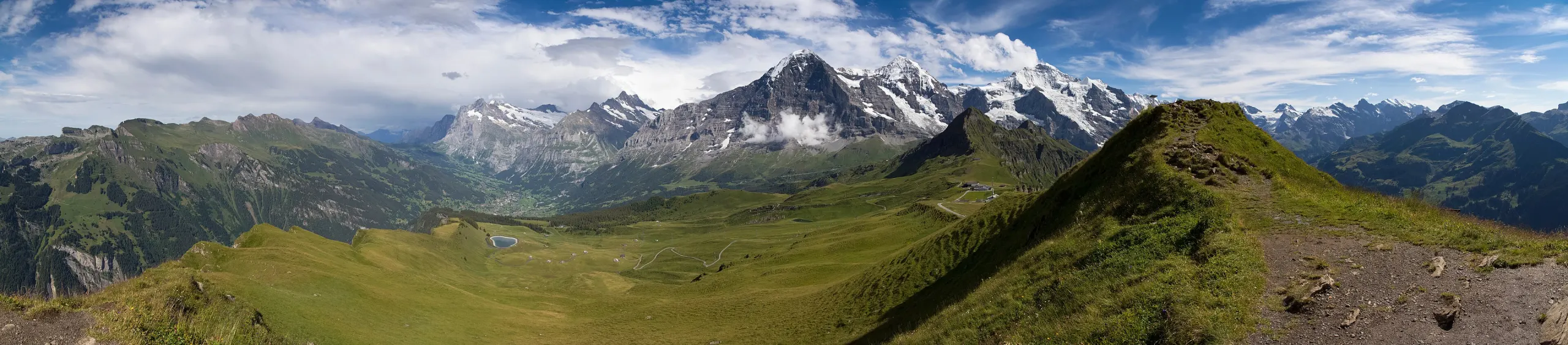
Reviewed
Sometimes. Jungfraujoch is worth it in clear weather if you specifically want Europe's highest railway station at 3,454 m, a glacier underfoot, and the Aletsch view — and if the live fare is not displacing something you would rather do. It is not worth it when summit cloud blocks the view; valley fog alone is not the deciding factor. The Swiss Travel Pass does not include the excursion. Compare the same return on the same date: on 2 October 2026 Jungfrau Railways' calculator priced Grindelwald Terminal to Jungfraujoch and back at CHF 249.20 without a discount, CHF 189.60 with the Swiss Travel Pass, and CHF 129.60 with the Swiss Half Fare Card — the figure the operator advertises as its from-price. Check the live fare and webcams before buying.
The Joch against Schilthorn, First and Gornergrat.
Same weather, different exposure to it, and very different fares.
| Excursion | What you get | Weather sensitivity | Pass position | Where it starts |
|---|---|---|---|---|
| Jungfraujoch | Europe's highest railway station at 3,454 m, the Sphinx deck, the Aletsch Glacier underfoot | Highest: in summit cloud you have bought a tunnel ride | Not included; 25% off with the Swiss Travel Pass, 50% with the Swiss Half Fare Card | Grindelwald Terminal via the Eiger Express, or Interlaken Ost; on 2 October 2026 the Grindelwald Terminal return was CHF 249.20 without a discount and CHF 129.60, the advertised from-price, with the Half Fare Card; seat reservation mandatory 1 May to 31 October 2026 |
| Schilthorn | A revolving restaurant and a 360-degree panorama facing the Eiger, Mönch and Jungfrau; cable-car ascent | Lower: a view of the wall rather than from it survives an imperfect day better | Check the current fare and pass rate on the operator's page | Stechelberg or Mürren |
| Grindelwald First | A lower, cheaper walking day with the cliff walk; built around being outside | Low: a walking day loses less in a mediocre sky | Check the current fare and pass rate on the operator's page | Grindelwald |
| Gornergrat | A cog railway to a Matterhorn-facing ridge; the closest like-for-like substitute | High, like any summit view | Check the current fare and pass rate on the operator's page | Zermatt, detached from both regions this site covers; include the transfer |
What the fare actually buys
It buys the highest railway station in Europe, at 3,454 metres, reached through a tunnel bored inside the Eiger and the Mönch; the Sphinx observation deck; and a view down the Aletsch Glacier, the largest in the Alps and a UNESCO World Heritage site. It is a genuine feat and a genuine sight, and nothing else in the region substitutes for it exactly. It also buys a lot of time indoors, a summit complex that is busy, and an experience whose value is dominated by the weather. The operator advertises the return 'from CHF 129.60' via the Eiger Express, but its own calculator on 2 October 2026 returned that figure as the Half Fare Card price from Grindelwald Terminal. Without a discount the same return was CHF 249.20, and CHF 271.20 from Interlaken Ost; with the card from Interlaken Ost it was CHF 140.60. The calculator does not say whether the CHF 10 seat reservation, mandatory from 1 May to 31 October 2026, is included; the booking total settles it.
The weather is the whole decision
This is the part that ought to be said first and usually is not. You are paying a premium fare for a view, and if the summit is in cloud you have bought a tunnel ride and a gift shop. Jungfrau Railways runs live webcams at the top precisely because this is the deciding variable, and the discipline is simple: keep the Joch as a floating day rather than a booked one, look at the cameras in the morning, and go when the mountain is out. If your trip is short enough that you cannot float the day, that is itself an argument for one of the cheaper alternatives, which suffer far less from a mediocre sky.
The alternatives, honestly compared
Schilthorn, above Mürren, gives you a revolving restaurant, a 360-degree Alpine panorama that faces the Eiger, Mönch, and Jungfrau rather than standing inside them, and a cable-car ascent instead of a tunnel — many people prefer the view of the famous wall to the view from it. Grindelwald First is a different product entirely: lower, cheaper, and built around walking, the cliff walk, and getting outside rather than into a summit building. Gornergrat, above Zermatt, is a cog railway to a Matterhorn-facing ridge, and it is the strongest like-for-like substitute if you are on that side of the country — though Zermatt is detached from both of the regions this guide covers, and you should price its return on the operator's own site. None of these is the Jungfraujoch. All offer more time outdoors and can lose less of their appeal on an imperfect day. They can cost less, but compare the same origin, date and pass entitlement; include the transfer to Zermatt for Gornergrat.
So who should actually buy it
Buy it if this is likely your only Swiss trip, the weather is good, and the idea of standing on a glacier at 3,454 metres is a thing you specifically want rather than a thing you feel obliged to tick. Buy it if you have children who will find the tunnel, the ice palace, and the snow genuinely thrilling. Do not buy it because it is famous, do not buy it when the summit webcam shows the view is blocked, and do not buy it if the live fare is coming out of the budget for the outdoor days that would have been the better trip. And do not budget it as covered by a Swiss Travel Pass, because it is not.
The questions people actually ask.
Use the short answers below to settle the practical details before you book.
Is Jungfraujoch worth it?
In clear weather, and if you specifically want Europe's highest railway station at 3,454 m, a glacier underfoot, and the Aletsch view, yes. When summit cloud blocks the view it is not — you are paying a premium fare for a view that will not be there. The operator advertises the return from CHF 129.60, but on 2 October 2026 that was the Half Fare Card price from Grindelwald Terminal; without a discount the same return was CHF 249.20. Check the live fare and webcams before you buy.
How much does Jungfraujoch cost?
It depends on the departure station, date, and entitlement. On 2 October 2026 Jungfrau Railways' price calculator returned a return from Grindelwald Terminal at CHF 249.20 without a discount, CHF 189.60 with the Swiss Travel Pass, and CHF 129.60 with the Swiss Half Fare Card; from Interlaken Ost it returned CHF 271.20 without a discount and CHF 140.60 with the card. On that date the operator's advertised 'from CHF 129.60' matched that Half Fare Card figure. A CHF 10 seat reservation is mandatory from 1 May to 31 October 2026, and the calculator does not say whether its totals include it. The Good Morning Ticket takes 20% off the first two early departures, with departure from Jungfraujoch by 13:17. It cannot be combined with a Swiss Travel Pass or Swiss Half Fare Card.
Is Schilthorn better than Jungfraujoch?
Schilthorn can be cheaper depending on your origin and pass, is outdoors, reached by cable car rather than a tunnel, and it faces the Eiger, Mönch, and Jungfrau instead of standing among them—many visitors prefer the view of the famous wall to the view from it. Jungfraujoch is the higher, rarer experience, often at a higher fare: Europe's highest railway station and a glacier. Schilthorn suffers less from an imperfect day.
What are the alternatives to Jungfraujoch?
Schilthorn above Mürren, for a revolving restaurant and a panorama facing the Eiger, Mönch, and Jungfrau. Grindelwald First, for a lower, cheaper walking day with a cliff walk. Gornergrat above Zermatt, a cog railway to a Matterhorn-facing ridge — the closest like-for-like substitute, though Zermatt is detached from the Bernese Oberland and Lake Lucerne regions; price its return on the operator's own site.
The mistakes that cost money here.
Fares, opening, and mountain conditions can change. Check the current detail with the linked operator.
Booking it days ahead for a fixed date and then going anyway with the summit in cloud because the ticket is bought.
Assuming the Swiss Travel Pass covers it. It does not — you get valley legs and a discount, not the excursion.
Treating the advertised CHF 129.60 from-price as your end-to-end quote. On 2 October 2026 the operator's calculator returned it as the Half Fare Card price from Grindelwald Terminal; without a discount the same return was CHF 249.20, and CHF 271.20 from Interlaken Ost.
Buying it out of obligation on a short trip when the same money would have bought three outdoor days you would have enjoyed more.
Keep the plan coherent.
Move between guides by decision type: the pass, the region, the village, the big excursion, the mountain, and rail versus road.
Where to stay in the Jungfrau region
Compare Interlaken, Grindelwald, Lauterbrunnen, Wengen, and Mürren by rail access, car access, luggage, scenery, and evening atmosphere.
Swiss Travel Pass or point-to-point tickets: the honest arithmetic
2026 Swiss Travel Pass prices start at CHF 254 (2nd class, adults 25+). Compare the cost with point-to-point tickets and the Half Fare Card.
Pilatus, Rigi, or Titlis: which Lake Lucerne mountain to actually do
Compare Pilatus, Rigi, and Titlis by journey, scenery, weather risk, and Swiss Travel Pass coverage before choosing a Lake Lucerne mountain day.
Every price here names the operator it came from.
Fares, opening, seasons, and mountain conditions change. This page gives planning advice and a dated reference; the sources below hold the current fare, opening, and conditions.
- Jungfrau Railways — Jungfraujoch, Top of EuropeThe Jungfraujoch excursion itself: the Eiger Express and Jungfrau Railway routing, the Sphinx observation deck, opening, and current conditions at the top.
- Jungfrau Railways — prices and ticketsCurrent Jungfraujoch, Eiger Express, First, and Schynige Platte fares, the Good Morning Ticket, the seat reservation, and the operator's price calculator by departure station, date, and entitlement.
- Jungfrau RailwaysThe operator of the Jungfrau region's mountain railways and lifts: which lines run in which season, live webcams, and the mountain conditions that decide whether an excursion is worth the fare on the day.
- Schilthorn — Piz GloriaThe Schilthorn cableway from Stechelberg and Mürren: current fares, the revolving restaurant, and the alternative high viewpoint to Jungfraujoch on the same side of the valley.
- Gornergrat BahnThe Gornergrat cog railway above Zermatt: current fares and timetable for the Matterhorn-facing alternative to a Jungfrau-region high excursion.
- SBB — Swiss Travel Pass coverageWhat the Swiss Travel Pass actually includes: trains, buses and boats, public transport in over 90 towns and cities, panorama trains excluding required reservations and/or supplements, the named included mountains, and the discount rate on other mountain excursions.
- Travel Switzerland — Jungfraujoch pass discountsThe excursion-specific distinction: 25% off Jungfraujoch with the Swiss Travel Pass or Flex, 50% with the Swiss Half Fare Card, and a seat reservation mandatory from May to October.
- Grindelwald TourismusGrindelwald context: the Grindelwald Terminal and Eiger Express, the First excursion, the village's road access, and current visitor information.
How we verify
Prices and operating details are checked against the responsible operator or public authority and dated. Cultural context, confirmed local information and editorial advice are retained even when an external page does not repeat them; conflicting facts are checked individually.